How to Recover Properly After Hip or Knee Surgery Without Losing Strength or ConfidenceNew Blog Post
Hip and knee surgery is meant to fix the problem.
But what most people are not prepared for is what comes next.
The stiffness.
The weakness.
The uncertainty.
The fear of pushing too hard.
The frustration of not feeling “normal” yet.
You might be walking.
You might even be cleared to increase activity.
But deep down, you know something is still missing.
Strength.
Control.
Confidence.
And here is the part most people are not told clearly:
Surgery repairs the structure.
Rehabilitation restores performance.
Those are two very different things.
Why Most Recoveries Stall
After surgery, you are usually given:
Early mobility exercises
Basic strengthening
Walking advice
A discharge timeline
That gets you mobile.
It does not necessarily get you strong.
Many patients plateau around the 8–12 week mark because:
Muscle inhibition remains
Joint confidence is reduced
Load tolerance is not fully rebuilt
Movement patterns adapt subtly
You start avoiding certain movements.
You shift weight slightly differently.
You descend the stairs carefully.
You hesitate before longer walks.
These small changes accumulate.
If not addressed, they can:
Limit long-term strength
Reduce endurance
Affect gait symmetry
Increase risk of secondary problems
That is where structured rehabilitation becomes critical.
The Real Goal After Surgery
The goal is not just to walk without pain.
It is to:
Restore muscular strength
Restore joint confidence
Restore full range control
Rebuild load tolerance
Prevent compensatory patterns
True recovery means your operated-on leg performs just as confidently as the other.
That requires progressive loading.
Not passive recovery.
Why Load Progression Matters
After hip or knee surgery, your body needs a gradual return to stress.
Too little load and muscles weaken.
Too much load and swelling increase.
The key is precision.
At our clinic, we look at:
Gait symmetry
Joint tracking
Muscle activation
Stability under load
Confidence with progression
We build recovery step by step.
Because long-term strength is not accidental.
It is engineered.
The Microgravity Advantage
One of the biggest challenges post surgery is weight-bearing progression.
Walking at full bodyweight can feel uncomfortable early on.
That often slows confidence.
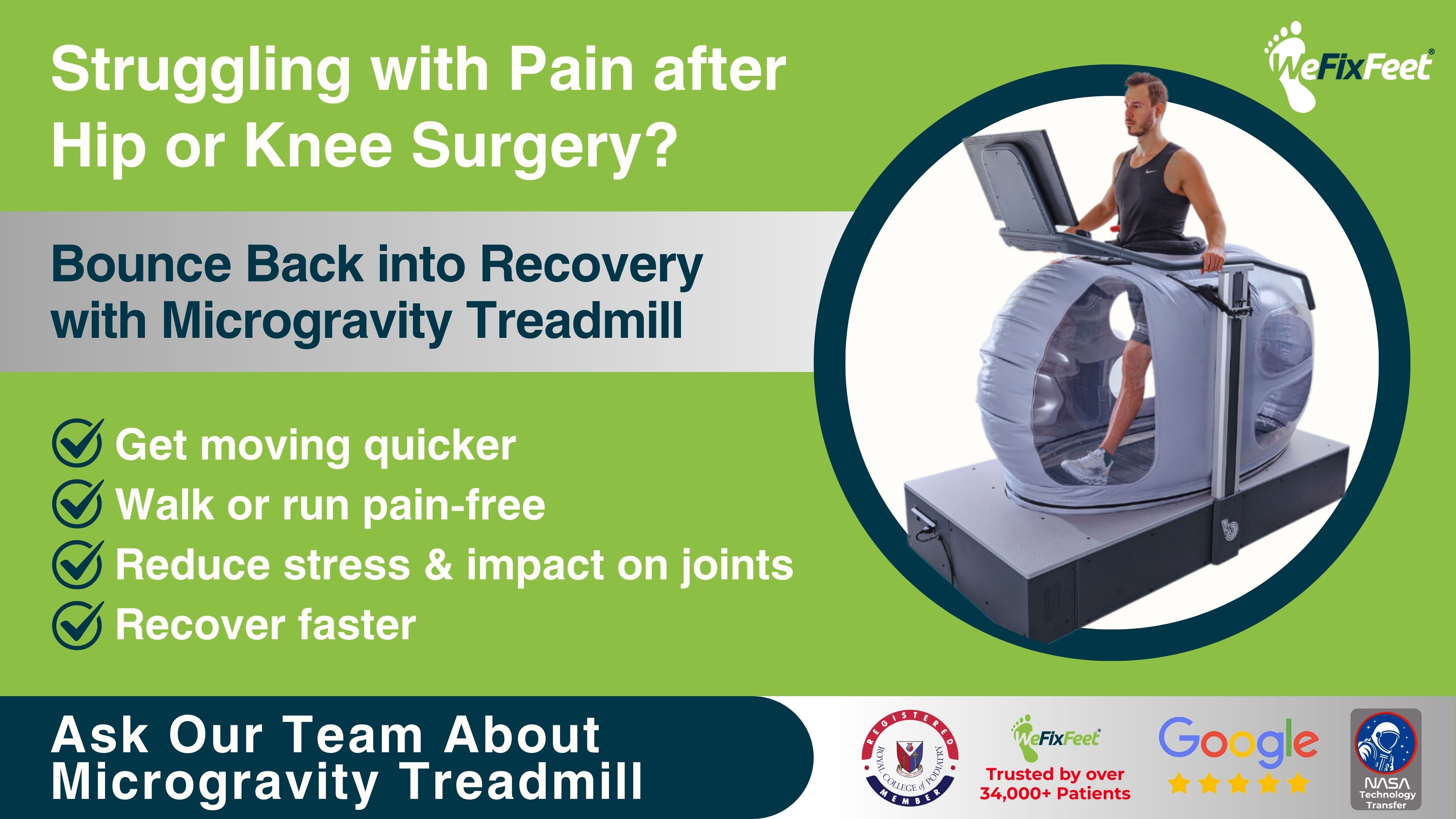
This is where the Microgravity treadmill becomes extremely powerful.
It allows you to:
Walk at reduced bodyweight
Rebuild gait mechanics
Improve confidence
Increase stride length gradually
Reduce joint compression
Progress load precisely
Instead of avoiding walking distance, we adjust our body weight and maintain safe movement.
This accelerates:
Neuromuscular re-education
Muscle activation
Controlled endurance
We are currently the only podiatry and sports therapist-led clinic in Nottingham offering this technology.
When integrated into structured rehab, it significantly changes recovery timelines.
Strength Is More Than Leg Press Numbers
Post-operative strength is not just about building quads.
It includes:
Glute stability
Hip rotational control
Single-leg balance
Tendon resilience
Controlled deceleration
If you return to activity without restoring these, subtle compensations remain.
Over time, that can lead to:
Opposite side pain
Lower back irritation
Knee tracking issues
Reduced performance capacity
Structured rehabilitation prevents that.
When Is It Safe to Push Harder?
This is the question most patients ask, but rarely get a precise answer to.
The correct answer is not time-based alone.
It is function-based.
We assess:
Swelling response
Pain tolerance
Load symmetry
Muscle activation timing
Movement efficiency
When those markers are stable, progression is appropriate.
When they are not, forcing intensity slows recovery.
Progression should be measured.
Not guessed.
What Recovery Should Feel Like
Properly progressed recovery feels:
Challenging but controlled
Slightly fatigued but stable
Stronger week by week
Confident under load
It should not feel:
Uncertain
Instable
Inflamed repeatedly
Stuck at the same level
If you feel stalled, it is usually because progression is not being structured properly.
Who Structured Post-Op Rehab Is For
This is not for someone satisfied with basic mobility.
It is for people who want:
Full-strength restoration
Return to sport
Confident hiking or travel
High activity levels
Long-term joint resilience
It is especially relevant if you:
Were active before surgery
Plan to return to sport
Want symmetrical strength
Do not want recurring flare-ups
What a Post-Operative Rehab Assessment Includes
A one-hour structured assessment includes:
Full biomechanical review
Gait analysis
Muscle activation testing
Load tolerance evaluation
Movement efficiency review
Clear progression roadmap
Where appropriate, Microgravity integration is trialled within the session.
You leave with clarity.
Not just exercises.
The Long-Term View
The biggest mistake post surgery is assuming the job is done once the pain reduces.
True recovery is strength, control, and confidence.
If you invest properly in that stage, you:
Reduce long-term complications
Improve performance capacity
Prevent secondary strain
Extend joint longevity
Your surgery fixed the structure.
Now the focus shifts to optimising the system.
Final Thought
Hip and knee surgery is not the end of your activity.
It is a reset.
The question is whether you:
Drift back slowly
Or rebuild deliberately
Structured rehabilitation gives you control over that decision.
If you want a clear plan for regaining strength and confidence after surgery:
Book a Post-Operative Rehabilitation Assessment on 0115 9223377
Because recovery should not feel uncertain.
It should feel progressive.
